




Una donna per amico
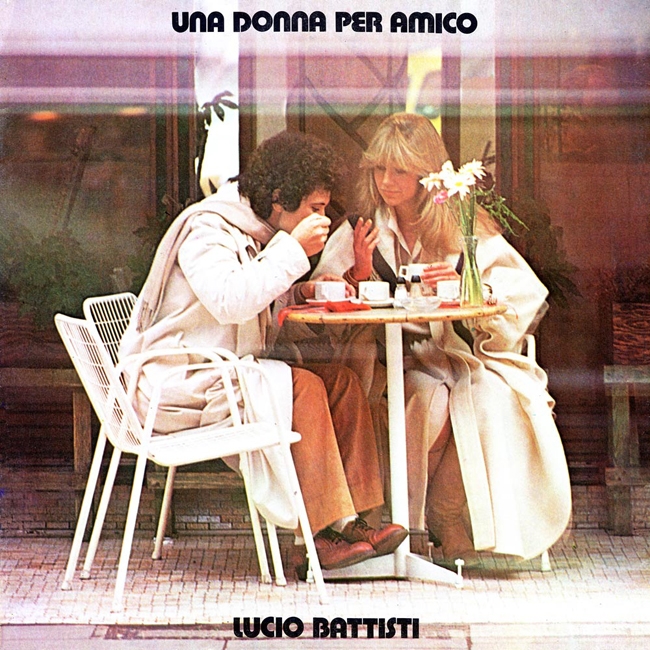
Io tu noi tutti (I You Us Everyone) was rather homogeneous. The songs resembled each other quite a bit. On Una donna per amico on the other hand, there are different compositional moments. However, there’s something common to all the tracks, the fact of all being part of an expressive genre common to all the nations of the western world. If you want people to understand you, as an artist you have to by necessity use a language that is as far-reaching as possible. Many people could interpret this as a voluntary narrowing of their creative abilities. In my opinion, it isn’t true. At first glance, something like that might seem very simple, but in no way is that the case. In fact, the things you do always have to be customized. Even if the music you play is basically the music you can hear in London or New York, you have to understand that it’s Lucio Battisti! At the moment, my artistic efforts are aimed precisely in this direction, in other words, to be part of an international discourse, using an appropriate language without losing my characteristics as a musician. On Una donna per amico, I limited myself to writing the songs with Mogol and then of course singing them. I didn’t play an instrument in the studio, not even the acoustic guitar. I really enjoyed working with Geoff Westley. We got along right away. When I made him listen to a tape with the pieces, his first thought was, “In each of them, we need to highlight the most peculiar feature”. And this is another reason that the album is so heterogenous.
Every song was studied at length and this is why we have an extremely rhythmic song like Una donna per amico and then a simple and linear waltz like Perché no. The musicians who participated in the recording were able to freely express their creativity. I had amazing session men working with me. They come from the best that the British scene has to offer today, from Gerry Conway, the drummer for Cat Stevens, to guitarist Pip Williams, who as a hobby, is also a producer for Status Quo.
Excerpt from: Bagli, Aldo, Ho scoperto il lavoro d’equipe. Intervista a Lucio Battisti, “Ciao 2001”, no.43, October 29, 1978, Rome, pp. 23-25
Estratto da: Bagli, Aldo, Ho scoperto il lavoro d’equipe. Intervista a Lucio Battisti, «Ciao 2001», n.43, 29 ottobre 1978, Roma, pp. 23-25