




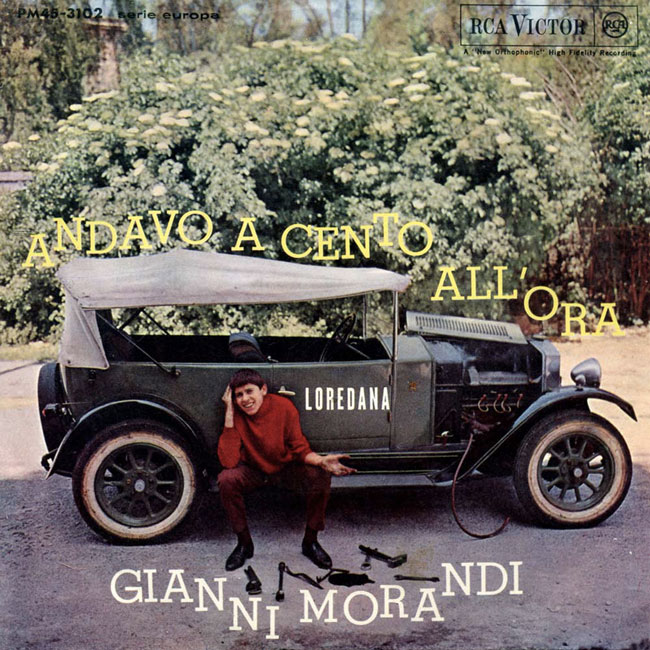
Andavo a cento all’ora
It was actually on a summer’s day between Bellaria and San Mauro Mare that I had the fateful meeting with the former boxing referee Paolo Lionetti. As well as having been a sports professional, Lionetti was a salesman of lubricating oils and also managed a hundred jukeboxes, which he kept up to date by stocking up at the “Disco d’Oro” on Via Indipendenza in Bologna. It meant replacing 70-80 45 rpm records each time, and the shop owner had become a friend of his. The two men, thanks to their excellent relationship with record companies, decided one day to write to an acquaintance at RCA to get an appointment. They assured him they had a “champion” on their hands. With his cocky boasting Romagna style, Lionetti immediately told me clearly that he would handle my career: “Don’t worry. We’re going to be successful and if you don’t make it with your songs, you can always become a boxer: yes, with those big hands and long arms you can be a good featherweight… Because when I refereed Robinson for the world championship…”. And he told me about some of his glory days in the ring. “I’ll make you into a god. I’ll make you into an actor…”. Later he found out that Celentano had contacted me because he wanted me in his Clan: “You’re not going! I’ll smash your face in because there he wants to keep you down. He always wants to be number one, and instead, one day you’re going to be number one!” Another time he threatened to shoot me in the legs if I agreed to make a film with Bellocchio. Then he would challenge me to see how many plates of tagliatelle pasta I could eat. Coming from a poor family, I didn’t often have the chance to eat a plate of tagliatelle heaped with meat sauce: so I felt I could win any bet, eating as many as five platefuls.
Lionetti took me to Rome for an audition. RCA was an American recording company whose Italian branch was wanted by the Vatican to create jobs during the crisis of the post-war period. It was established in Rome despite the fact that most Italian recording companies were located in Milan. Galeazzi Lisi, the Vatican’s man whose job it was to form the board of directors, put Ennio Melis at the company’s helm. He came from a Jesuit background, and proved to be very capable, generating extraordinary turnover in just a few years, higher than those of all the other European branches, soon confirming RCA to be the best record company in Europe. To his credit, Melis created a very respectable stable of artists and even invented, thanks to the musicians he chose, a recognizable “RCA sound” superior to that of all other labels. I also think about this when I think back on the course of my career: “If they had taken me to Milan, to another record company, what path would I have taken? Other authors, other songs, another life…” Lionetti and I left for Rome in his Fiat 1100. We stayed in the Piazzale Clodio area, at the Pensione Busso. There something else quite interesting happened: in fact, I met a girl who was staying in the room next to mine and who’d just arrived from Turin with her mother. Her name was Rita Pavone. Going in to RCA, I felt like I was in another world. Were records made in such a huge establishment? And how many people worked there! We started the audition. It was Thursday, the only day of the week when auditions were held. They told me that I didn’t sing badly but that my Emilian accent was too strong. So my audition was archived along with other not particularly exciting auditions.
But once again fate made its decision regardless of tastes and opinions: a Tuscan lyricist who was also at my audition noticed me. It was Franco Migliacci. His role as a talent scout meant that he always paid close attention to who came into RCA. One day, evaluating a song that went “I was going at a hundred an hour to visit my baby …”, written by a miner who had emigrated to Belgium, a certain Tony Dori, he wondered who could sing it. It needed a nice young singer, with scads of determination. While he was thinking of someone who could best perform that unpretentious song, his foot got caught in a tape of Geloso that fell off the archive shelf. Why turn down what fate has suggested? Franco immediately decided to listen to that tape and on hearing it, he remembered me and my audition. From that day on, Maestro Migliacci, a pillar of Italian popular song, became my producer, songwriter and friend.”
Morandi, Gianni (con Michele Ferrari), Diario di un ragazzo italiano, Milano, Rizzoli, 2006, pp. 91-94